
Tire Noise and Vibration: Balance Problems Explained
Discover More On
Tire noise and vibration may come from imbalance, uneven tread, tire damage, a bent wheel, or worn suspension. Our wheel balancing in Parma, OH, measures each assembly so we can correct imbalance without guessing.
At Parma Car Care Specialists, we inspect the tire, wheel, and nearby parts. Balancing cannot repair a separated tire, bent rim, bad bearing, or worn steering part.
What Tire Noise Can Tell You
Balance problems are felt more often than heard. Noise often points toward tread, tire damage, a bearing, a brake, or another rotating part.
Cupped Tread Can Hum or Roar
Tire cupping noise may sound like humming, roaring, or a rhythmic drone. High and low tread sections strike the pavement unevenly.
Imbalance may contribute to wear, but weak shocks, alignment problems, and poor inflation also cause cupping. Balancing cannot erase an existing tread pattern.
Thumps, Clicking, and Scraping Need Inspection
A thump can indicate a flat spot, separated belt, bulge, or tread object. Clicking may come from debris, while scraping can involve brakes or wheel contact.
Stop driving with a bulge, exposed cord, rapid pressure loss, or severe vibration. Ohio's tire safety guidance emphasizes recommended tire pressure, adequate tread depth, and freedom from major tire damage.
Where You Feel the Vibration Matters
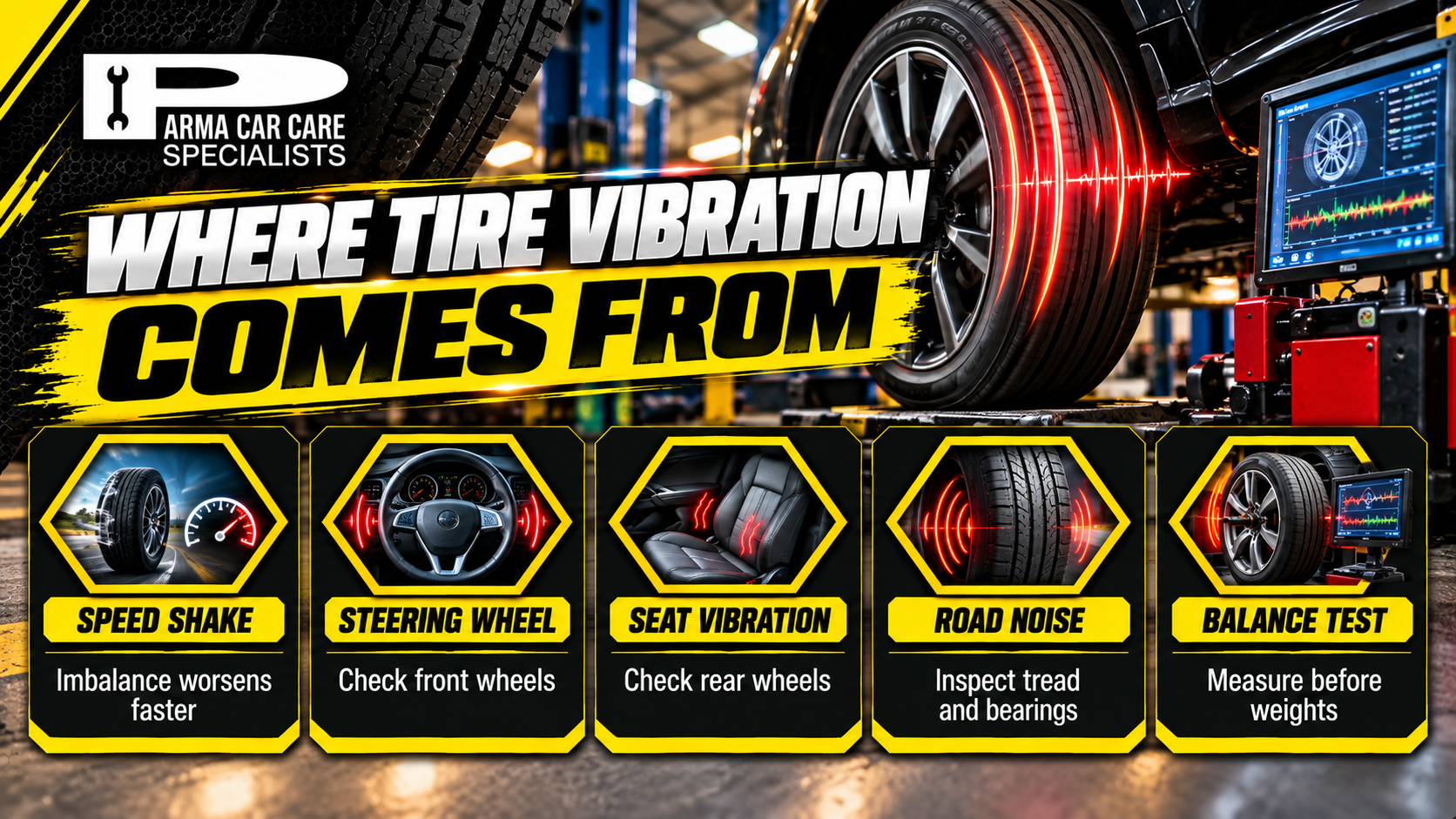
Vibration location narrows the first inspection area, but motion can travel through the steering, seats, floor, and body.
Steering-Wheel Shake Often Starts at the Front
Front imbalance often reaches the steering wheel first. It may feel like a side-to-side shimmy or fine buzz.
Loose steering parts, a bent wheel, tire damage, or alignment wear can feel similar. Our suspension and steering repair in Parma, OH, covers unexplained shaking.
Seat or Floor Vibration Often Starts at the Rear
Rear imbalance may reach the seat, console, or floor more than the steering wheel. Passengers may notice it first.
Driveline, exhaust, and rear suspension faults also cause body vibration. A road test checks whether the pattern follows speed, load, turning, or road surface.
Brake-Only Vibration Points Somewhere Else
Vibration only during braking is not typical wheel imbalance. Brake rotor variation, caliper movement, or worn suspension may be involved.
Note whether the pedal, steering wheel, or body pulses. This separates braking concerns from constant highway vibration.
Balance, Alignment, Tire Damage, or Suspension Wear?
Several faults create shaking or noise, sometimes together. Inspection matches the symptom to tire condition, wheel runout, alignment, and component wear.
Alignment Changes Direction and Wear Patterns
Alignment sets wheel angles. Poor alignment often causes pulling, an off-center steering wheel, feathered tread, or edge wear.
Balancing distributes rotating weight, not wheel angles. Both services may be needed when a vehicle shakes, pulls, and wears tires unevenly.
Tire and Wheel Damage Can Mimic Imbalance
A bent wheel, out-of-round tire, belt problem, or poor bead seating may vibrate after balancing. Runout or road-force testing can identify it.
Severe damage may require replacement instead of more weight. Our guide to wheel alignment after hitting a pothole in Parma, OH, explains how tire damage, bent wheels, and vibrations can affect the repair decision.
Worn Suspension Can Create Cupping
Weak shocks or struts let a tire bounce against the pavement. Loose joints or bushings also change tread contact.
Inspect the vehicle before repeated balancing. Our services include tire, wheel, alignment, and suspension care for many makes, including Mitsubishi repair in Parma, OH.
What Happens During Professional Wheel Balancing?
Professional balancing measures the complete assembly and corrects weight distribution. It also identifies damage that weights cannot fix.
Inspect the Tire and Wheel Before Balancing
Technicians check pressure, tread, sidewalls, beads, wheels, and weights. They look for bulges, objects, bent rims, and uneven wear.
The wheel is mounted on balancing equipment. Clean surfaces and proper centering support an accurate reading.
Measure, Correct, Torque, and Verify
The machine identifies the imbalance. Technicians add or reposition weights, then spin again to verify correction.
After installation, lug fasteners are tightened to specification. A road test may confirm that the original speed-sensitive vibration is gone and reveal any remaining tire, wheel, or suspension issue.
How Parma Roads and Weather Affect Wheel Balance
Potholes after Northeast Ohio freeze-and-thaw cycles can bend wheels, damage tires, or knock off weights. Snow and ice packed into a wheel can create a sudden shake on State Road or Snow Road that disappears after the buildup melts.
Do not assume every winter vibration is temporary. If shaking continues on a clear wheel or returns on I-480, inspection can separate imbalance from impact damage or worn parts.
Takeaways
Wheel imbalance usually causes a vibration that changes with vehicle speed. Steering-wheel shake often starts at the front, while seat or floor vibration may begin at the rear.
Noise, brake-only pulsation, pulling, bulges, and uneven tread point toward other possible faults. Inspect the complete tire-and-wheel assembly before deciding that balance weights alone will solve the problem.
Frequently Asked Questions
What do unbalanced tires sound like?
Unbalanced tires may not make a distinct sound by themselves. Humming, roaring, or rhythmic noise often comes from uneven tread, cupping, damage, or a bearing that needs inspection.
Why does my steering wheel shake around 60 mph?
Wheel imbalance is a common reason for steering-wheel shake near highway speed. Tire damage, a bent wheel, worn steering parts, or alignment-related wear can create a similar symptom.
Can wheel balancing fix tire noise?
Wheel balancing generally does not fix tire noise, but it can reduce vibration caused by uneven weight distribution. Noise from cupped tread, internal tire damage, a wheel bearing, or a brake component may require additional inspection.
Is it safe to drive with a vibrating tire?
Driving with a vibrating tire may be unsafe, depending on the cause and severity of the vibration. Stop and inspect the vehicle promptly if shaking is severe or the tire shows a bulge, pressure loss, exposed cord, or visible damage.
Do I need alignment after wheel balancing?
Alignment is not automatically required after balancing because the services correct different problems. An alignment check is appropriate when the vehicle pulls, the steering wheel is off-center, or the tread wears unevenly.
Schedule Tire and Wheel Diagnosis in Parma
Parma Car Care Specialists can inspect tire noise, locate speed-sensitive vibration, and determine whether balancing or another repair is needed. Call (216) 741-0446 and describe the speed, road condition, and vehicle area where you notice the symptom.
Our shop is at
5481 State Road, Parma, OH 44134. Bring any recent tire-service history and mention whether the vibration began after a pothole, tire repair, rotation, or seasonal wheel change.
How Wheel Imbalance Creates Vibration
Wheel imbalance means weight is unevenly distributed around a rotating assembly. The resulting force can create a repeating shake through the suspension and body.
Heavy and Light Spots Change Rotating Force
A small weight difference matters at road speed. A balancing machine locates heavy and light areas, then guides weight placement.
Weights can fall off, and tire repair or remounting can change balance. Snow, ice, mud, or debris inside a wheel may create a temporary imbalance.
The Shake Often Changes With Speed
Unbalanced tire symptoms often appear within a speed range and strengthen as speed rises. The shake may fade outside that range but still deserves inspection.
Steering wheel vibration at highway speeds is a familiar clue on I-480. A shake tied to engine rpm may have another source.

About the author:
Fred Cerny
Fred Cerny has owned Parma Car Care Specialist since 1989, steadily expanding the business from its humble beginnings with just three bays to a modern facility with eleven bays today. With over 40 years of automotive service and repair experience, Fred has become a trusted name in the community.
He is a certified Master ASE Technician, holding certificates in all nine ASE areas, demonstrating his comprehensive expertise. His background includes a degree in electrical engineering, which has proven to be a valuable asset in diagnosing and repairing today’s increasingly complex vehicles.
Throughout his career, Fred has built a reputation for consistently getting the job done right the first time, emphasizing quality workmanship and professionalism. He is known for his attention to detail and his commitment to customer satisfaction. Fred treats his clients like family, earning their trust and loyalty through honest service and transparent communication.
Under his leadership, Parma C.C.S. has grown not only in size but also in reputation, becoming a go-to destination for reliable automotive care in the area. His dedication to excellence and his passion for cars continue to drive the success of the business, making it a trusted name for vehicle repair and maintenance in the community.
